



Having multiple similarities, the countries of Central Asia significantly vary with respect to key economy sectors architecture and primary energy resources consumption, which eventually leads to differences in their present structure of GHGs emissions.
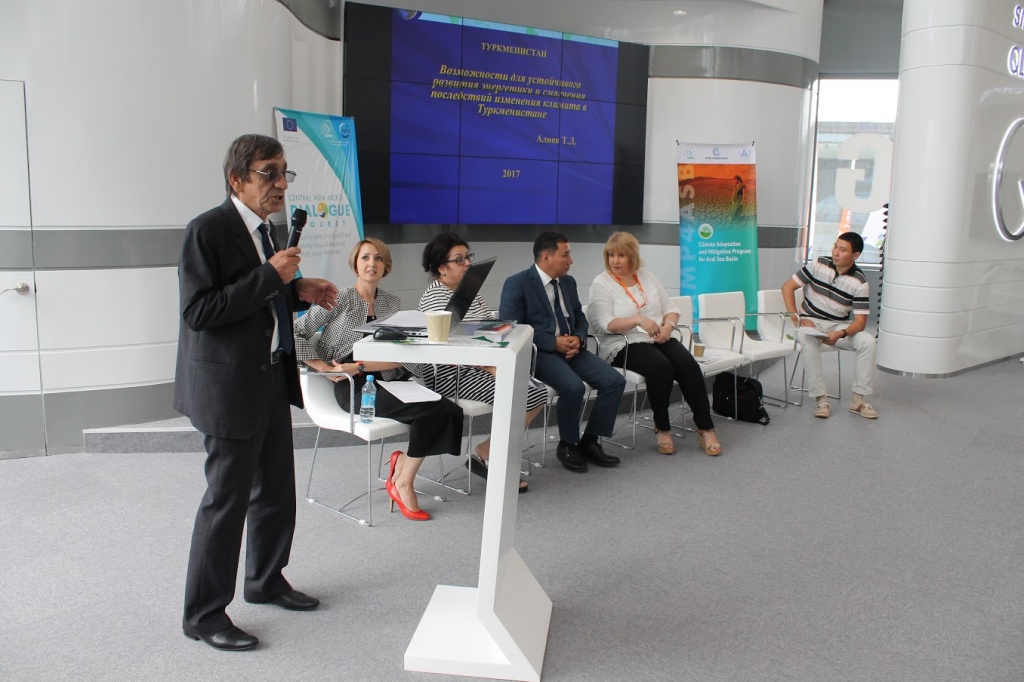
On July 11, at the World Expo-2017 in Astana, within the framework of the CAMP4ASB project, a session "Low-carbon development in Central Asia and opportunities for regional cooperation" was held, at which experts from Central Asia presented national strategies, plans and approaches for low-carbon development and climate resilience.
The participants were greeted by the Ms. Gayane Minasyan, Lead Environment Specialist, World Bank.
Report on the theme “Linkages between low-carbon development path and committed pledges in Kazakhstan’s INDC" was presented by Mr. Nurzhan Kabdoldanov, Deputy Director of the JSC “Zhasyl damu“, Republic of Kazakhstan.
“Linkages between GHG emission reduction/ climate resilience and committed pledges in Tajikistan’s INDC“ were presented by Ms. Firuza Nasyrova, Senior Specialist of the International Relations Department, Committee for Environmental Protection under the Government of the Republic of Tajikistan.
A presentation "Opportunities for sustainable energy development and climate change mitigation in Turkmenistan" was made by Mr. Teimur Aliyev, Deputy Director of the CSO Tebigu Kuvvat.
Ms. Natalya Agaltseva, Head of Department of projects preparation and monitoring, the Centre of Hydrometeorological Service (Uzhydromet) under the Ministry of Emergency Situations, provided information on “Linkages between low-carbon development path through the use of sustainable energy principles and committed pledges in Uzbekistan’s INDC“.
“Assessing benefits from the regional cooperation on low-carbon development in Central Asia“ was presented by Mr. Yerbol Akhmetbekov, Director of the Laboratory on Energy, Ecology and Climate, Centre for Energy Research, Nazarbayev University.
Within this session, representatives of Central Asian countries will present national strategies, plans and approaches to low carbon development. The panelists will discuss necessary conditions for sustainable and coherent low-carbon growth in the region.
After presenting national perspectives, the panel session participants discussed opportunities for regional cooperation, which offers additional contribution to reduction of GHGs in the Central Asian countries.
It should be noted that most of the existing national strategies and plans for the "green economy" in the countries of Central Asia reflect the individual policies of each country. However, without taking into account the interests and needs of neighboring countries, individual approaches can not provide the necessary sustainable and comprehensive growth of the country and region in the long term. This was emphasized by all the speakers of the session "Low-carbon development in Central Asia and opportunities for regional cooperation".